1. Decide what the packaging must do
Branded shipping packaging has three jobs: protect the product, keep postage and storage costs down, and make the first moment with the product feel like your brand. These pull in different directions. A thick rigid box protects well but costs more to ship; a thin PE mailer is cheap to post but gives little protection and little brand effect. Start by listing your products by size, weight and fragility, and by sales channel: your own Shopify store, Amazon, Allegro, Etsy or others.
2. Choose the format
- Printed corrugated mailer boxes: self-locking, with tuck flaps. The standard for apparel, cosmetics, accessories and gifts.
- Shipping cartons: plain or printed with a logo, for larger or heavier orders and for multi-item parcels.
- PE mailers: light polyethylene bags with a self-seal strip, for textiles and unbreakable items.
- Inner packaging: printed tissue paper, crinkle paper fill, air cushions, stickers and thank-you cards.
Our mailer boxes and shipping category shows the catalogue models with factory MOQs.
3. Get the size right
Size is where most of the money is. Parcel carriers price by weight and size class, and some by volumetric weight. A box that is a few centimetres too large can push a parcel into the next class. Empty space also needs fill, which adds cost and work.
- Measure the product in its retail packaging, plus tissue.
- Choose two to four box sizes that cover most of your orders.
- Check each size against the size classes of your main carriers.
- Keep minimisation in mind: the EU Packaging Regulation targets empty space in shipping and e-commerce packaging.
Give inner dimensions in millimetres when you ask for a quote. Outer dimensions depend on the board thickness.
4. Board grade
Corrugated board comes in different flute sizes and wall constructions. A fine flute gives a smooth print surface and suits light items. A thicker flute or double wall suits heavy or fragile products. Ask the supplier for the board construction and the liner colour: brown kraft, white or white-printed. If you ship glass or ceramics, test the box with your actual product and fill before deciding.
5. Print outside, inside or both
Many sellers print a simple logo outside and the bigger design inside. A plain outside attracts less attention in transit, while the inside print gives the unboxing moment. Common choices:
- one- or two-colour flexo print on kraft: economical and quick to approve;
- full-colour print on white board for photographic designs;
- inside print for a message, pattern or care instructions;
- hot-foil stickers or printed tape instead of printing the box, for small quantities.
Printed boxes are priced by quantity break, for example 500, 1,000 or 5,000 pieces, plus a set-up for plates or screens. We check your artwork and send a digital mock-up before production. Our private label page explains the approval steps.
6. Inner packaging that earns its place
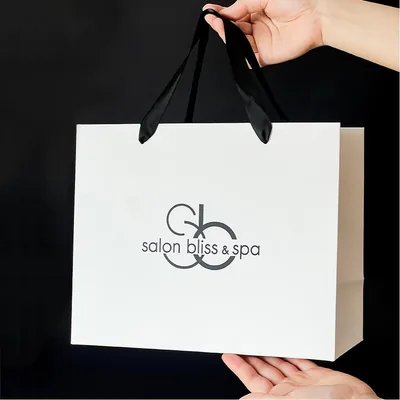
Printed tissue with a repeat logo, a ribbon or a seal sticker turns a plain product into a gift. Keep it simple: one wrap of tissue and one sticker look deliberate, while three layers of fill look wasteful. If you also sell in a store, use the same tissue and ribbons as the boutique bags so the brand looks the same in both channels.
7. Marketplaces have their own rules
Each marketplace sets its own requirements for packaging, labels and prepared stock, and these change. Before you order, check:
- whether the marketplace or its fulfilment service accepts your box for shipping as is;
- barcode, label and carton requirements for stock sent to fulfilment centres;
- whether you must give an EPR registration number for packaging in certain countries;
- the size and weight limits of the services you use.
If your products themselves are consumer products, the marketplace will also ask for GPSR information: the EU economic operator, contact details and safety information. That applies to the product, not the mailer box.
8. Packaging EPR for online sellers
Online sellers who ship packaged goods to consumers in another EU country can have EPR obligations in that country, not only at home. Germany has the LUCID register, Poland the BDO database, France its EPR schemes with Triman and Info-tri labelling, Italy CONAI. Rules and fees differ, so check with your EPR scheme. We give you the material and weight data per item for your reports, but we do not register for you.
9. Compare quotes on the packed order
The cheapest box per piece is not always the cheapest packaging. Compare the full cost of one packed order: box, tissue, sticker, fill, label and the postage class the box falls into. A slightly more expensive box that saves a size class or the need for fill often wins. Ask every supplier to quote the same inner size, board construction, print colours and sides, and packing per carton, so the numbers can be compared line by line. Also check how the flat boxes are packed: bundles that are easy to count and store save time at the dispatch desk.
10. Sampling and testing
- Pack your heaviest and most fragile product and drop the box from table height on each corner.
- Check that the self-locking flaps stay closed without tape, or plan for tape.
- Check print colour against your brand colours under daylight.
- Ship one sample through your normal carrier to yourself.
Samples are credited against the order.
11. Storage and reorders
Mailer boxes are delivered flat, but they still take space. Plan quantities against your storage and your sales curve, with Black Friday and Christmas peaks in mind. Printed packaging for the peak should be ordered by late August–September. A repeat order with the same artwork is faster and usually needs no new set-up.
12. Thermal labels and the dispatch desk
Thermal labels on rolls, sized for your printer and carrier, and a few packing tools are easy to forget. Add them to the packaging order so that the dispatch desk is ready on the same day as the boxes.
Next step
Send us your product sizes, monthly order volume and logo. We suggest box sizes and return an offer with quantity breaks within 2 working days. Request a quote.