1. Choose the bag type by use
Paper bags fall into three families, and each suits a different shop:
- Kraft carrier bags with twisted or flat paper handles: grocery stores, pharmacies, bakeries, everyday fashion. Made on automatic lines, so unit prices are low and minimums are moderate.
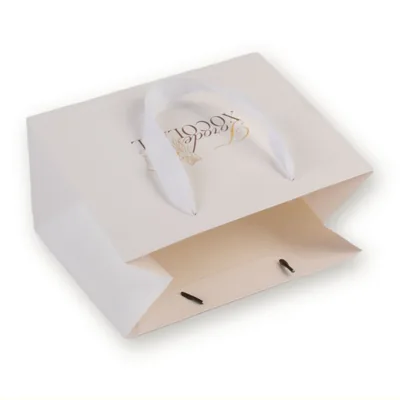
- Boutique bags in art paper or coated board with rope or ribbon handles: fashion, jewellery, cosmetics, gift shops. Hand-finished, laminated or uncoated, with reinforced tops and bases.
- Takeaway and bakery bags without handles or with flat handles, sometimes with a window: food service. These touch food and need a declaration of compliance from the manufacturer.
Our paper bags category shows the catalogue models with factory MOQs and “from” prices.
2. Paper and weight
Paper weight is given in grams per square metre (gsm). As a rough guide:
| Use | Typical paper |
|---|---|
| Light retail, pharmacy, bakery | Kraft, lighter gsm |
| Fashion, shoes, books | Kraft or white kraft, medium gsm |
| Boutique, jewellery, cosmetics | Art paper or coated board, heavier gsm, often laminated |
Ask for the gsm on every quote. Two bags of the same size can look alike on a photo and differ widely in weight, stiffness and price. Brown kraft shows the fibre and takes ink more softly. White kraft gives cleaner colours. Coated art paper gives the sharpest print and takes lamination and hot foil well.
FSC paper is available on request; ask for the certificate chain for the specific order rather than assuming it.
3. Size and gusset
Give sizes as width × gusset × height in millimetres. Measure the largest product you will pack, plus room for tissue paper or a gift box. Most shops need two or three sizes, not five. Each extra size adds a set-up cost and splits the quantity across smaller runs, which raises the unit price.
For shoes and boxed goods, a wider gusset matters more than height. For fashion, a taller bag keeps folded garments flat.
4. Handles
- Twisted paper handles: strong, low cost, attached by machine. The usual choice for kraft carrier bags.
- Flat paper handles: glued inside the top, good for bakeries and food stores.
- Cotton or polypropylene rope: knotted through punched holes with a reinforced top. Standard on boutique bags.
- Satin or grosgrain ribbon: the most decorative choice for jewellery and gifts; can be printed with your logo.
- Die-cut handles: a hole cut in the bag itself, with a reinforcement patch.
Test the handle with your heaviest load, lifting and putting the bag down several times. A handle that tears at the till damages the brand more than a plain bag would.
5. Print methods
The method depends on the quantity, the paper and the artwork:
- Flexo: the standard for kraft carrier bags on automatic lines. One to several spot colours, efficient for larger runs. Plates are a one-off set-up cost.
- Offset: for full-colour photographs and fine detail on art paper, usually before the bag is formed. Suits boutique bags.
- Screen print: strong, opaque colour, for example white on dark kraft. Suits smaller runs with simple logos.
- Hot foil stamping: gold, silver, copper or coloured foil for logos on laminated or coated bags. Needs a foil die.
- Embossing and debossing: a raised or pressed logo, often combined with foil.
- Spot UV: a gloss layer on part of a matt laminated bag.
Send vector artwork (AI, PDF or EPS) with Pantone references. We check the file and send a digital mock-up before production. Our private label page explains the approval steps.
6. Finishes
Matt or gloss lamination protects the print and adds stiffness, and it changes the material mix of the bag. Soft-touch lamination feels premium but marks easily. An uncoated bag with one strong colour is often the better choice for an everyday bag, both for cost and for simpler packaging reporting under the national EPR schemes.
7. How pricing works
Printed bags are priced by quantity break, for example 500, 1,000 and 5,000 pieces, plus a set-up for plates, screens or foil dies. The price per bag falls as the quantity rises, and the set-up is spread over more pieces. Repeat orders with the same artwork usually carry no new set-up.
When you compare quotes, check that they quote the same:
- size, gsm and paper type;
- handle type and attachment;
- number of print colours, sides printed and method;
- lamination and finishes;
- packing per carton and carton size.
A quote that leaves out the handle reinforcement or prints one side instead of two is not cheaper, just different.
8. Samples and approval
For a first order, ask for a blank sample in the chosen paper and handle, then a printed pre-production sample where colour is critical. Check the print against your Pantone, the glue lines, the base, and how the bag stands when empty. Keep the approved sample as the reference for inspection. Samples are credited against the order.
9. Common mistakes
- Choosing a dark full-flood colour on kraft paper: the brown base dulls the colour, so ask for white kraft or a white underprint.
- Putting fine text or thin lines in a flexo design: small details fill in, so keep lines and text above the minimum the printer gives you.
- Ordering five sizes at the minimum each instead of three sizes in larger quantities.
- Forgetting the inside: a printed inner side or a coloured base adds cost, so decide it at the quote stage.
- Matching the bag to the tissue, ribbon and hang tags too late: order them together so that the colours come from the same approval.
A bag rarely works on its own. Tissue paper, ribbons and hang tags with the same logo complete the look, and ordering them in one run keeps colours consistent and freight in one shipment.
10. Lead time and season
Plan on about 8–12 weeks from order to our warehouse for printed bags. For Christmas, order by late August–September. Bags are light but take volume, so they travel by rail or sea in most cases, and air is only economic for small urgent runs.
Next step
Send us the sizes, quantities, your logo and how the bags will be used. We return an offer with two or three quantity breaks within 2 working days. Request a quote.